



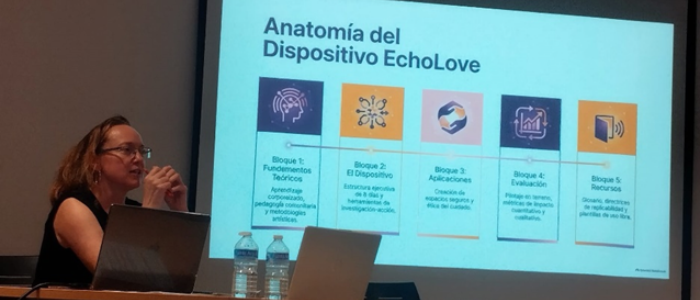
Notus presents the tools and findings of the European EchoLove project to prevent relationship-based violence amongst young people
On 25 September, Notus organised a transfer and dissemination event in Barcelona for the European EchoLove project: The Ecology of Affective Relationships (project KA210-YOU-000351558, co-funded by the European Union’s Erasmus+ programme).
The event brought together professionals from the fields of education, social work and youth services to gain first-hand insight into the results, materials and pedagogical foundations of this initiative, developed through a transnational partnership between APS Creativi108 (Italy, as the lead organisation specialising in artistic-bodily methodologies) and Notus (Spain, as the research partner responsible for the conceptual framework and the design of the impact assessment system).
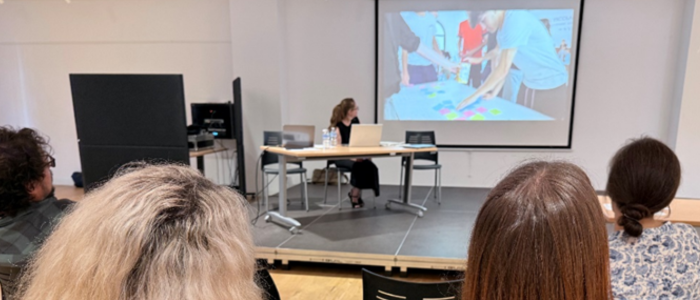
Learning to recognise toxicity through the body: Bodied Learning
The project tackles a significant social challenge: the prevention of gender-based relational violence and controlling behaviours among young people aged between 15 and 20, given the lack of formal spaces for emotional literacy.
During the conference, the EchoLove methodological framework was presented, based on social choreography, body awareness (mindfulness) and embodied learning (Bodied Learning). As explained in the session, interpersonal relationships manifest somatically before the mind processes them. Through movement, stage work and a non-verbal gestural glossary, the framework enables young people to identify tensions, boundaries and power imbalances within a safe space informed by trauma awareness, free from judgement or moral pressure.
The project’s tools enable the assessment of relational behaviours using a clear matrix of indicators:
- Warning signs of control and dependency (Red Flags): Constant digital monitoring, isolation from one’s circle of friends, loss of autonomy in decision-making, and fluctuation between idealisation and devaluation.
- Indicators of healthy relationships (Green Flags): Open communication, unconditional respect for individual autonomy, trust and the clear establishment of shared boundaries.
Evidence from the real-world pilot: From experimentation to data science
The meeting saw the sharing of results from the co-creation and piloting programme carried out throughout 2025 and 2026 in various contexts:
- Artist residency in Bologna (DAS Hub): Intensive co-design workshop with students from Liceo Sabin.
- Pilot in Barcelona / Vic (FEDAC School): An intensive 5-hour intensive pilot study with 24 high school students (ages 16–18), demonstrating that the tool effectively adapts to demanding timeframes and diverse cultural contexts.
- Public event: Presentation as part of the 30th edition of the Danza Urbana Festival in Bologna (Quartiere Navile).
Open-access resources and transfer to organisations
During the session, the structure of the Erasmus+ Programme (KA210-YOU) was presented, highlighting how this type of small-scale partnership facilitates pedagogical innovation and transnational cooperation that is accessible at a local level.
All materials developed within the project are available under an open licence (CC BY 5.0) for free use, adaptation and replication by teachers, educators and youth workers:
- EchoLove Handbook: A comprehensive practical teaching guide available in three languages (ES, IT, EN).
- Non-Formal Education Toolkit: Step-by-step teaching sheets with timings and classroom facilitation sequences.
- Educational Poster and Assessment Templates: Printable tools for identifying ‘red flags’ and editable questionnaires to measure impact in any educational context.
🔗 Access to materials:
The materials, teaching sheets and the complete handbook can be downloaded free of charge from the project’s official website: www.echolove.eu.

Comments are closed.