



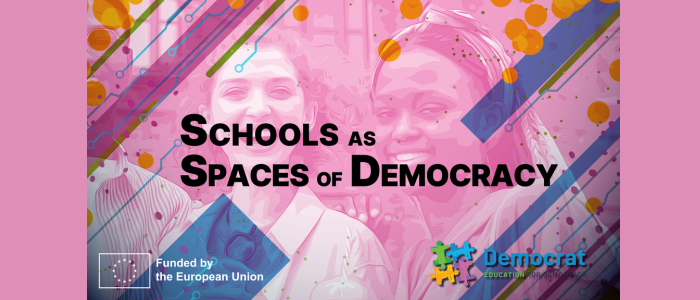
The European DEMOCRAT project concludes with the publication of its final results
On 28 February, DEMOCRAT (Education for Responsible Democratic Citizenship), an initiative funded by the Horizon Europe programme in which Notus has participated as a consortium member for the last three years, will officially conclude.
Coordinated by the University of Barcelona, the project’s main objective has been to strengthen democratic resilience in the European Union by designing a framework of competences for democratically responsible citizenship, as well as promoting education for democracy and developing innovative pedagogical materials.
Available Resources
The results of the project are divided into four pillars, which correspond to the different phases of our research and action:
1. Theoretical Framework and Diagnosis
These documents establish the basis for our current understanding of ‘Responsible Democratic Citizenship’ (RDC) and ‘Education for Democracy’ (EfD).
- Conceptual Framework of Responsible Democratic Citizenship (RDC): Defines the dimensions of democratic citizenship in the 21st century, integrating sustainability and digitalisation.
- Inequalities Analysis: A report analysing how socioeconomic status and the educational system influence the political engagement of young people. This is key to understanding why some groups participate less than others.
2. The “DEMOCRAT Toolbox” and Resume
This valuable resource is aimed at educational centres and youth organisations. As well as being able to access information on the various pilot projects developed in the six countries participating in DEMOCRAT, you can also find:
- Transnational Curriculum Framework: Concrete proposals on how to incorporate democratic education into existing subjects (history, ethics and science), without overwhelming the school curriculum.
- Teaching units and teaching guides: Classroom-ready materials that use active methodologies such as project-based learning, discussions and role-playing to develop empathy, critical thinking and deliberation competences.
3. Lessons from the Living Labs and the interventions carried out
Information based on the practical implementation of the pilot projects.
- Evaluation of the Pilot Projects: Includes details of the strategies that were and were not effective in centres where the DEMOCRAT model was applied. This is a ‘learning guide’ for those who wish to replicate these workshops in their own local contexts.
- Handbook of Practical Recommendations: Provides tips on managing student participation and involving families in democratic education.
4. Advocacy and Policy Recommendations
This is aimed at school management teams, technical education teams, and policymakers.
- Policy Briefs: Short executive documents summarising the necessary legislative or management changes to protect democracy in schools.
- Sustainability Roadmap: A plan for DEMOCRAT outcomes to be integrated into local educational networks and continue beyond project completion.
Contribution of Notus
Throughout the project, the Notus team has led and collaborated on the preparation of various technical and analytical reports, which are available to view in the ‘Deliverables’ section of the project website. The following stand out among the documentation drafted with the participation of Notus:
- Analysis of Inequalities and Participation (D3.2): A detailed study on how socio-educational inequalities influence the exercise of democratic citizenship.
- Evaluation of the Pilot Projects (D5.3): Notus has coordinated the evaluation of the “Living Labs” and pilot projects developed in six European countries, drawing key conclusions for the implementation of education policies at EU level.
- Guides for Local Implementation: Collaboration in the drafting of practical recommendations for educational and social organisations on how to apply the DEMOCRAT framework in their local contexts.
In addition to these documents, the Notus team collaborated with the University of Barcelona on fieldwork to assist with the development and implementation of pilot projects in Spain, primarily in Catalonia. Two articles have also been written for the DEMOCRAT project website, with the aim of sharing some reflections reflections on the democratic challenge in the classroom and how to educate in times of mistrust and presenting some of the initial results of the pilot projects we are supporting in Catalonia. These experiences offer a concrete vision of how democratic practices can be incorporated into the daily life of educational centres. Finally, the Spanish and Catalan Agora has also been energised through the publication of various documents, interviews, and contributions from technicians and teachers.
At Notus, we view the results achieved and our collaboration with the international partners of the consortium very positively. Completing this stage consolidates knowledge that will be fundamental in guiding future public policies on inclusion and democratic education in Europe.
All the information and final documents can be found on the project’s official: https://democrat-horizon.eu/

Comments are closed.